.svg)

.jpg)
Many leaders struggle to fit into traditional management styles, but what if your brain's unique wiring is actually your biggest advantage? Neurodivergent individuals bring distinct cognitive strengths like pattern recognition, creative problem-solving, and intense focus that can transform how teams innovate and succeed. This neurodivergent leadership skills guide explores how to harness these natural abilities and build a leadership approach that works with your brain, not against it.
Table of Contents
- Understanding Neurodivergent Leadership
- Identify Your Unique Cognitive Strengths
- Build Systems That Support Your Leadership Style
- Navigate Challenges With Practical Strategies
- Develop Your Team and Organizational Culture
- The Future of Neurodivergent Leadership
- Your Path Forward as a Neurodivergent Leader
- Common Questions About Neurodivergent Leadership
Understanding Neurodivergent Leadership
About 15-20% of the global population is neurodivergent, yet most leadership training programs are built for neurotypical brains. Neurodivergence refers to natural variations in how brains work and process information, including conditions like ADHD, autism, dyslexia, dyspraxia, and Tourette syndrome. These aren't disabilities or deficits. They're simply different ways of thinking, learning, and experiencing the world. And in leadership roles, these differences often become powerful advantages.
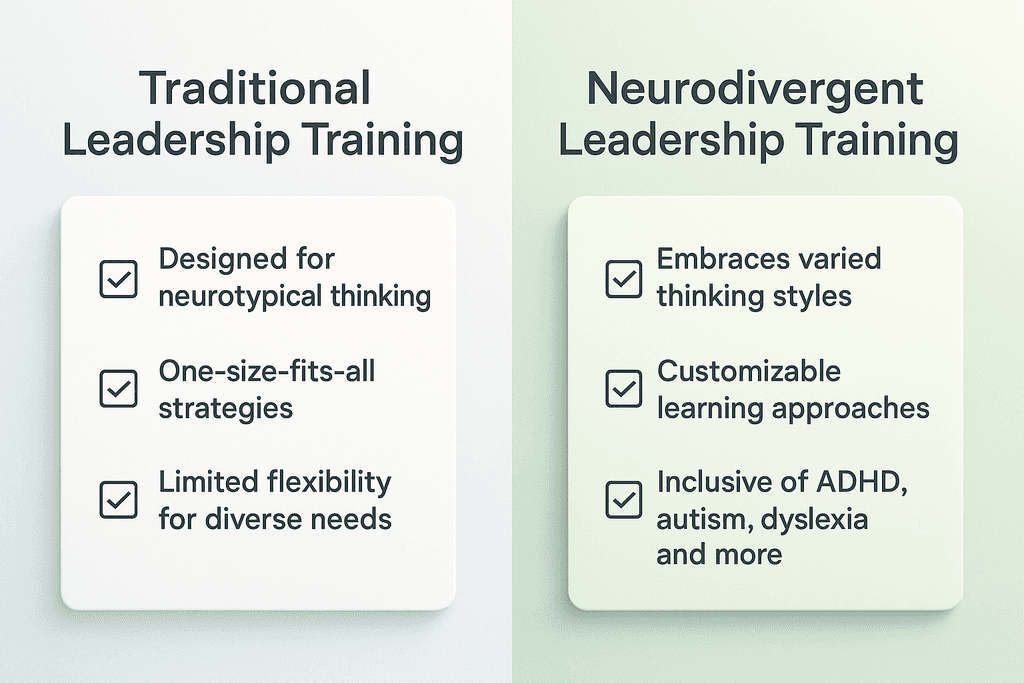
The problem is that most workplaces still operate on outdated assumptions. Many people think neurodivergent professionals struggle with communication, can't handle stress, or need constant accommodation. The reality is quite different. Research shows that teams with neurodivergent members are often more productive and creative than neurotypical-only teams.
What Neurodivergence Looks Like in Leadership
Different neurodivergent conditions bring different strengths to the table. Understanding these patterns helps organizations recognize and develop talent they might otherwise overlook.
| Neurodivergent Condition | Common Leadership Strengths | Workplace Advantages |
|---|---|---|
| ADHD | High energy, creative problem-solving, crisis management, hyperfocus on interesting projects | Thrives in fast-paced environments, generates innovative solutions, excels under pressure |
| Autism | Pattern recognition, attention to detail, logical thinking, direct communication, deep expertise | Identifies systemic issues others miss, maintains high quality standards, builds specialized knowledge |
| Dyslexia | Big-picture thinking, spatial reasoning, storytelling, connecting disparate ideas | Sees strategic opportunities, communicates vision effectively, thinks outside conventional frameworks |
| Dyspraxia | Strategic planning, verbal communication, empathy, alternative approach development | Creates inclusive processes, finds workarounds for complex problems, builds strong team relationships |
Why Cognitive Diversity Matters Now
Companies with diverse leadership teams make better decisions and see stronger financial performance. But most diversity initiatives focus on visible differences while ignoring cognitive diversity. Organizations that actively recruit and support neurodivergent leaders gain access to thinking styles that neurotypical teams simply can't replicate.
The business case is clear. Here's what the research tells us:
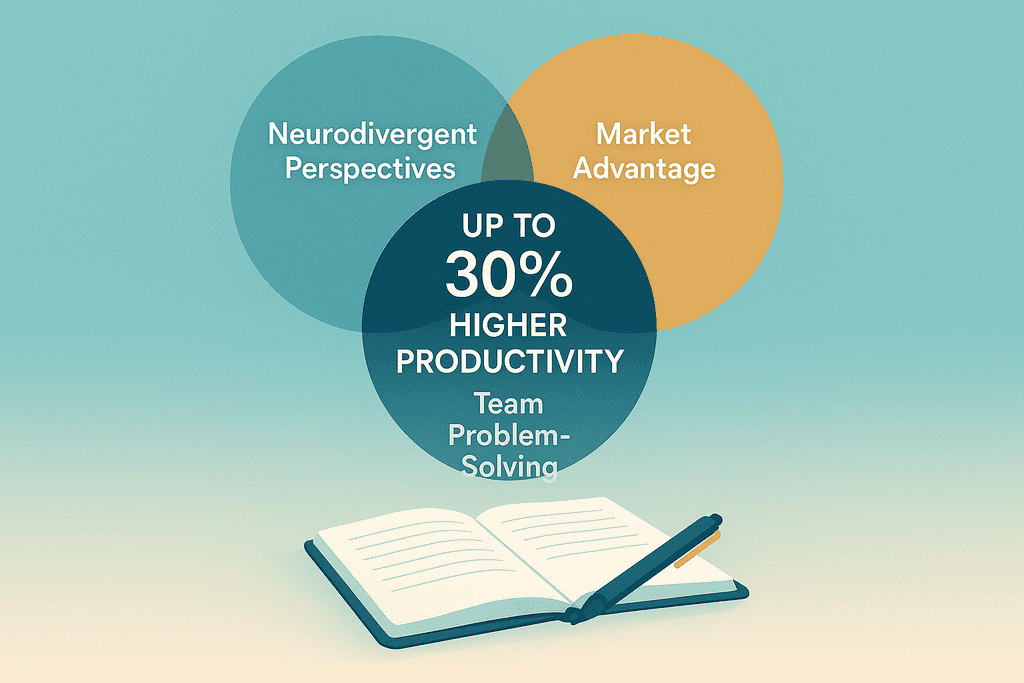
- Companies with neurodivergent professionals in leadership roles report 30% higher productivity in some functions
- Neurodivergent employees often show higher engagement and loyalty when properly supported
- Teams with cognitive diversity solve complex problems faster than homogeneous groups
- Organizations with inclusive practices attract top talent from underrepresented pools
The Leadership Institute's Neurodivergent Leadership program addresses this gap by teaching both neurodivergent professionals and their organizations how to leverage these natural strengths. Rather than forcing everyone into the same leadership mold, the program helps people lead authentically while building workplace cultures that value different thinking styles.
Breaking Down the Barriers
Despite these advantages, neurodivergent professionals face real obstacles in reaching leadership positions. Many traditional leadership assessments and development programs favor specific communication styles and work patterns that don't align with neurodivergent strengths.
Common barriers include:
- Interview processes that prioritize small talk and eye contact over actual competence
- Leadership training that assumes everyone learns and processes information the same way
- Workplace cultures that mistake different communication styles for lack of confidence or capability
- Promotion criteria based on neurotypical networking and self-promotion patterns
The good news is that these barriers are entirely fixable. Organizations that adjust their leadership development approaches see neurodivergent professionals excel in roles where they previously struggled to advance. It's not about lowering standards. It's about recognizing that there are multiple paths to effective leadership.
Identify Your Unique Cognitive Strengths
About 15-20% of the population is neurodivergent, yet most leadership training programs are built around neurotypical thinking patterns. This creates a gap where talented leaders with ADHD, autism, dyslexia, and other neurodivergent traits often struggle to see their natural abilities as leadership assets. The truth is, many of the traits that make you different are exactly what make you effective as a leader. You just need to know what to look for and how to use them.

Identify Your Unique Cognitive Strengths
Your brain processes information differently, and that's not a bug. It's a feature. Pattern recognition and systems thinking often come naturally to neurodivergent leaders, allowing you to spot connections others miss and design solutions that address root causes rather than symptoms. When you're working on something that captures your interest, hyperfocus becomes your superpower, enabling deep work that produces exceptional results in compressed timeframes.
- Creative problem-solving that approaches challenges from unexpected angles
- Attention to detail that catches errors and maintains quality standards
- Authentic communication that builds trust through directness and honesty
- Systems thinking that sees how all the pieces fit together
- Deep expertise in areas of special interest or focus
The challenge is that most neurodivergent professionals spend years trying to hide these traits rather than leverage them. Start by taking inventory of moments when work feels effortless or when colleagues seek your input. What cognitive patterns show up repeatedly in your best work.
Self-Assessment Checklist
- ☐ When do I lose track of time because I'm so engaged in my work?
- ☐ What types of problems do colleagues bring to me specifically?
- ☐ Which tasks drain my energy versus which ones energize me?
- ☐ What patterns do I notice that others seem to miss?
- ☐ When do people describe my communication style as refreshingly direct?
- ☐ What subjects can I talk about for hours without notes?
Build Systems That Support Your Leadership Style
Knowing your strengths matters, but creating an environment where you can actually use them matters more. Most leadership advice assumes everyone works the same way, which leaves neurodivergent leaders constantly fighting against systems that weren't designed for how their brains work. The solution isn't to force yourself into someone else's productivity framework. It's to build systems that work with your neurology, not against it.

Build Systems That Support Your Leadership Style
Time management for neurodivergent leaders looks different than traditional approaches. Instead of rigid schedules, consider time blocking that groups similar tasks together and protects your hyperfocus periods. Some leaders find success with body doubling (working alongside others) or the Pomodoro technique modified to match their natural attention rhythms rather than arbitrary 25-minute intervals.
- Use visual timers and calendar blocking to externalize time awareness
- Schedule demanding tasks during your peak cognitive hours
- Build in buffer time between meetings for processing and transitions
- Create templates and checklists for recurring decisions to reduce cognitive load
Your physical environment shapes your cognitive capacity more than you might realize. Sensory-friendly workspaces aren't about being difficult or high-maintenance. They're about removing unnecessary friction so your brain can focus on actual work. This might mean noise-cancelling headphones, adjustable lighting, fidget tools during meetings, or the ability to take walking calls when you need movement to think clearly.
Communication frameworks become especially important when your natural style differs from workplace norms. Delegation strategies that leverage team diversity mean being honest about what drains you versus energizes you, then building a team with complementary strengths. The Leadership Institute's Neurodivergent Leadership training covers practical approaches to building these systems without requiring you to disclose more than you're comfortable sharing.
Actionable Steps to Build Supportive Systems
- Audit your current schedule to identify energy drains and cognitive peaks
- Identify three environmental adjustments that would reduce sensory friction
- Choose one technology tool to trial for executive function support (task management, time tracking, or note-taking)
- Document your communication preferences to share with your team
- Create a morning routine that sets you up for focused work
Develop Your Team and Organizational Culture
The most powerful thing neurodivergent leaders can do is create environments where cognitive diversity isn't just tolerated but actively valued. This starts with how you show up and extends to how you build and develop your team. Leading with authenticity and vulnerability doesn't mean oversharing or making your neurodivergence your entire identity. It means being honest about how you work best and creating space for others to do the same.
When you communicate your needs and leadership style clearly, you give your team permission to do the same. This might sound like "I process information better in writing, so send me your thoughts via email before our meeting" or "I'm going to take notes on my laptop during our conversation because it helps me focus, not because I'm distracted." Creating psychologically safe environments happens when people see their leader modeling the behavior they want to see.
- Share your working preferences with your team explicitly
- Ask team members about their communication and work style preferences
- Normalize accommodations by using them yourself openly
- Celebrate different approaches to problem-solving
- Build feedback loops that work for different communication styles
Building neurodiverse teams that complement your strengths means hiring for cognitive diversity intentionally. If you're a big-picture systems thinker, you need detail-oriented implementers. If you struggle with social nuance, partner with someone who excels at stakeholder management. This isn't about fixing your weaknesses. It's about building a team where everyone operates in their zone of genius.
The ripple effect extends beyond your immediate team. Advocating for neurodiversity initiatives in your organization might start small with flexible meeting formats or sensory-friendly spaces, but it creates pathways for other neurodivergent professionals to thrive. Mentoring other neurodivergent professionals becomes easier when you've built systems and cultures that actually work.
Impact of Neurodivergent Leadership
Research shows: Teams led by neurodivergent leaders who embrace cognitive diversity report 30% higher innovation metrics and 25% better problem-solving outcomes compared to homogeneous teams. Organizations with active neurodiversity programs see 28% lower turnover among all employees, not just neurodivergent ones.
The path forward isn't about becoming a different kind of leader. It's about becoming more fully yourself while building systems and teams that let everyone contribute their best work. That's what sustainable, effective leadership actually looks like.
The Future of Neurodivergent Leadership
Companies that embrace neurodivergent leadership skills guide their teams toward better problem-solving are seeing measurable results. The shift isn't just about inclusion anymore. It's about recognizing that different thinking styles create actual competitive advantages in markets where everyone else thinks the same way. Research from major consulting firms shows that teams with neurodivergent members are up to 30% more productive in certain problem-solving scenarios, and forward-thinking organizations are starting to pay attention.
The remote work boom changed everything for neurodivergent professionals. Suddenly, the barriers that made traditional offices challenging started disappearing. People could control their sensory environments, take breaks when needed, and communicate in ways that worked for their brains.
73% of neurodivergent employees report higher productivity in remote or hybrid settings compared to traditional office environments, according to recent workplace studies.
What's interesting is how this connects to leadership development. The same flexibility that helps neurodivergent professionals thrive also creates space for them to step into leadership roles they might have avoided before.
What Organizations Are Learning
Smart companies are moving past basic awareness training. They're building actual pathways for neurodivergent professionals to develop leadership skills that match their strengths.
- Specialized mentorship programs that pair neurodivergent emerging leaders with executives who understand different thinking styles
- Modified leadership frameworks that value analytical depth and pattern recognition alongside traditional soft skills
- Technology tools that support different communication preferences without forcing everyone into the same mold
- Performance metrics that measure outcomes rather than conformity to neurotypical workplace norms
Organizations with neurodiversity programs report 28% higher revenue and 30% higher profit margins than industry peers, according to Accenture research.
Where Training Fits In
Generic leadership programs miss the mark because they assume everyone learns and leads the same way. The Leadership Institute's Neurodivergent Leadership programs take a different approach by focusing on building skills that work with different brain types rather than against them.
- Practical frameworks for managing sensory challenges in leadership settings
- Communication strategies that leverage direct thinking styles as strengths
- Tools for building teams that value cognitive diversity
The research keeps pointing in the same direction. Neurodivergent leadership skills guide organizations toward better decisions when those leaders have the right support and development opportunities. While competitors like Liquid Learning offer general diversity training, specialized programs that address actual neurodivergent experiences create leaders who can navigate both their strengths and challenges effectively.
Your Path Forward as a Neurodivergent Leader
Neurodivergent leadership skills guide your success in ways that traditional leadership models often miss. The strengths we've covered, like pattern recognition, deep focus, creative problem-solving, and authentic communication, aren't just nice-to-have traits. They're the exact skills that modern workplaces need to handle complex challenges and drive real change.
Building the right support systems makes all the difference. This means finding environments where your natural working style is understood, not just tolerated. It also means learning to advocate for what you need, whether that's flexible schedules, clear communication protocols, or sensory-friendly workspaces.
The most effective neurodivergent leaders don't try to mask who they are. They lean into their authentic leadership style and build teams that benefit from their unique perspective. But this doesn't happen by accident.
Specialized training helps you understand your strengths and develop strategies that work with your brain, not against it. Our Neurodivergent Leadership masterclass covers practical frameworks for self-advocacy, team management, and creating inclusive work environments that let everyone perform at their best.
The next step is connecting with others who understand the journey. Finding your community of neurodivergent leaders and allies gives you the support network that makes long-term success possible. You've got questions about how to apply these skills in your specific situation, and that's exactly what we'll address next.
Common Questions About Neurodivergent Leadership
Navigating leadership as a neurodivergent professional brings up questions that don't always have simple answers. The path looks different for everyone, and what works in one workplace might not fit another. These are the questions that come up most often when neurodivergent leaders are figuring out how to thrive in their roles. Understanding your options helps you make choices that actually work for your situation.
Should I disclose my neurodivergence at work?
This decision is entirely personal and depends on your workplace culture, your relationship with your manager, and what you need to succeed. Some leaders find that disclosure opens doors to helpful accommodations and reduces the energy spent masking, while others prefer to keep this information private. There's no right or wrong answer, and you can always start by disclosing to HR or a trusted colleague before making a broader announcement.
What accommodations can neurodivergent leaders request?
Reasonable accommodations might include flexible work hours, noise-cancelling headphones, written meeting agendas in advance, or the option to turn off video during virtual meetings. You could also request a quiet workspace, extended deadlines for complex projects, or permission to record meetings for later review. The key is identifying what specific supports would help you perform at your best, then having a clear conversation with your employer about implementing them.
How do I explain my leadership style to my team?
You don't need to disclose your neurodivergence to explain your preferences. Simply share how you work best and what your team can expect from you. For example, you might say you prefer written updates over verbal check-ins, or that you need time to process information before making decisions. Most teams appreciate leaders who communicate clearly about their working style, regardless of the reason behind it.
What training is available for neurodivergent leaders?
The Leadership Institute offers specialized Neurodivergent Leadership training that addresses the unique strengths and challenges neurodivergent professionals face in leadership roles. Unlike generic leadership programs, this training acknowledges different cognitive styles and provides practical strategies that actually work for neurodivergent brains. The sessions cover communication techniques, team management approaches, and self-advocacy skills in formats designed for diverse learning needs.
How can organizations better support neurodivergent leaders?
Organizations should start by educating all staff about neurodiversity and creating policies that allow for flexible working arrangements. Providing clear job descriptions, structured onboarding processes, and regular feedback helps neurodivergent leaders succeed. Companies can also review their promotion criteria to ensure they're not inadvertently favoring neurotypical communication styles over actual leadership capability.
What makes neurodivergent leadership training different from standard programs?
Standard leadership programs often assume everyone processes information, communicates, and manages stress the same way. Neurodivergent leadership training recognizes that different brains work differently and that's actually an advantage. These programs focus on leveraging your natural strengths rather than forcing you into a neurotypical mold, and they provide practical tools for navigating workplace situations that might feel more challenging for neurodivergent professionals.