.svg)

A man named Ron walked out of a cell in Goulburn Supermax — the most secure prison in Australia — and met Andrew Bartha at the gate. Ron had been locked up nearly 30 years. Every time the prison tried to put him through a program, he'd "kick off" and refuse.
Then Ron looked at Andrew and said: "In nearly 30 years, no one's ever asked me if I can read or write. And I'm ashamed of it."
Twelve months later, Ron had finished his two programs. Within 18 months, he'd been downgraded to minimum security. He went home. He's now married and doing well.
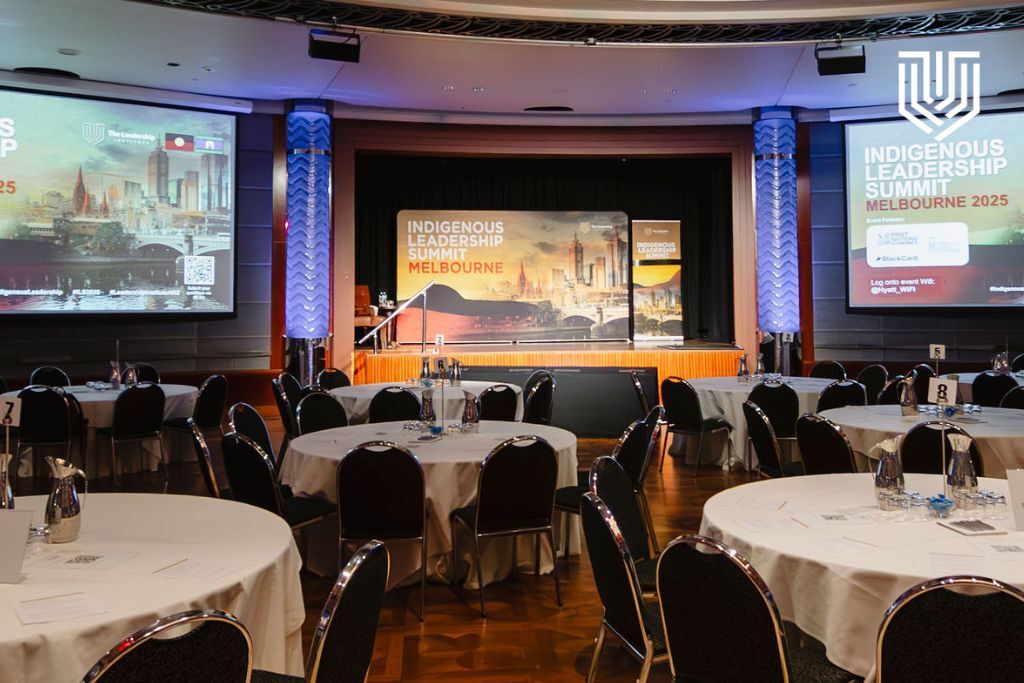
That story, told from the stage at Park Hyatt Melbourne, is the Indigenous Leadership Summit 2025 in a nutshell. Not a strategy. Just one person asking the right question.
Over two days on Wurundjeri Woi Wurrung Country, more than a dozen First Nations leaders shared yarns like that. Here's what we took away.
.jpg?width=1024&height=683&name=What%20We%20Learnt%20at%20the%20Indigenous%20Leadership%20Summit%202025%20(1).jpg)
Stop calling it diversity. It's exclusion.
Rachelle Towart OAM, founder of Pipeline Talent, quietly reframed half the conversations in the room: Aboriginal and Torres Strait Islander people don't belong in a "diversity bucket." We're the result of a system that has actively excluded us — and lumping us in with every other under-represented group lets organisations off the hook from looking at why we're missing.
The practical consequence? Recruitment built for mob. Rachelle's "black ground checks" verify cultural credibility, not Aboriginality. Her placements include 100 days of coaching for the candidate and the employer. As Rikki Cooper from BGIS put it: every role can be done by an Indigenous person. If your participation plan is asking which roles are suitable, your participation plan is the problem.
.jpg?width=1024&height=683&name=What%20We%20Learnt%20at%20the%20Indigenous%20Leadership%20Summit%202025%20(2).jpg)
Customary leadership is a working model, not a museum piece.
Marcia Langton spent her keynote on something most leadership conferences won't touch: our ways of leading aren't a heritage relic. They're a functional governance system that kept communities alive for 65,000 years.
Market leadership is what an MBA teaches you — command, hierarchy, KPIs. Customary leadership is relational, built around kinship, inclusion and accountability to the collective. The best Indigenous corporations in the country — ALPA, Yawuru, Murong Gajarrong — work because they've encoded customary leadership into their corporate constitutions. Elders councils. Family representation on boards. Mechanisms that stop one family being excluded and the whole thing falling apart.
You don't have to choose between bringing your culture and being effective. The most successful First Nations leaders bring customary ways into the boardroom and let them reshape what happens there.
.jpg?width=1024&height=683&name=What%20We%20Learnt%20at%20the%20Indigenous%20Leadership%20Summit%202025%20(3).jpg)
Cultural load is real. Allyship means stepping onto the bridge.
Rebecca Bateman closed the summit with a metaphor that hung in the air after she'd sat down.
There's a bridge between mob and the institutions we work in. Every day, we run back and forth across it — explaining, translating, reassuring nervous colleagues they won't break the bridge if they step on it. "Sometimes we have to get on the bridge and jump up and down like idiots," she said, "shouting 'it's safe, no one's going to die.'"
That running is cultural load. It's being the one who has to explain why Acknowledgement of Country matters. It's the email that lands in your inbox because you're the only Blackfella on the team.
Tony Armstrong said it in his fireside chat: "How good does it feel when someone else goes, 'no, hang on, I got this'?" That's allyship. It's not turning up to NAIDOC. It's noticing when a colleague is carrying something heavy and saying, I'll take this one.
.jpg?width=1024&height=683&name=What%20We%20Learnt%20at%20the%20Indigenous%20Leadership%20Summit%202025%20(4).jpg)
The best leaders never set out to be leaders
Michael O'Loughlin was a 17-year-old kid from Salisbury North who cried at the airport when his mum put him on a plane to Sydney. Twenty years on, he's a Hall of Famer and co-founder of the GO Foundation — which has supported over 2,200 First Nations kids through school, with a 97–98% Year 12 completion rate.
Kristy Dickinson started Haus of Dizzy by smuggling extra earrings into her handbag to flog in pub bathrooms. Now she's got a studio in Fitzroy, seven women on staff, and her jewellery has been worn on stage by Lauryn Hill.
Rebecca Bateman wanted to be a vet. Now she helps mob trace their families through the Stolen Generations archive at the National Library — including her own mum. "I didn't think I was a leader," she told the room. "But I am. And so are you."
If you're sitting there thinking I'm not a leader yet, you might be wrong about that.
.jpg?width=1024&height=683&name=What%20We%20Learnt%20at%20the%20Indigenous%20Leadership%20Summit%202025%20(5).jpg)
What now?
The Indigenous Leadership Summit isn't about leadership in the abstract. It's about what gets done on Monday morning.
Andrew asked Ron if he could read. Rachelle built a recruitment agency because she got tired of mob being last in the pile. Michael paid for a kid's home WiFi because you can't do Year 12 homework without it. Rebecca opened the National Library's archive to her own mum, then to a generation.
If one moment from those two days sticks with you — one question you start asking, one system you decide to challenge, one young person you decide to back — that's the summit doing its job.
Next summit: https://www.theleadershipinstitute.com.au/indigenous-leadership-summit/